Abstract
We introduce TurCOMET, the first Turkish-specific augmentation of COMET for evaluating translations between Turkish and English. By extending xCOMET-XL with Turkish morphological features and training it on additional Turkish-English data via an additive bottleneck layer, TurCOMET resolves neural evaluation failures caused by sub-word over-segmentation. To validate our metric, we introduce TurkDoc-MT, a meticulously curated Turkish-English document-level aligned dataset of 1,322 instances spanning seven domains. Meta-evaluation demonstrates that TurCOMET significantly outperforms the off-the-shelf baseline, yielding absolute Kendall’s τ correlation gains of +0.113 (system-level) and +0.024 (segment-level), with the largest gains in the TR→EN direction. All models, datasets, code, and annotations are publicly released for the benefit of Turkish natural language processing and benchmarking any translation system.
Paper & poster
Read the full camera-ready paper or the EMNLP 2026 poster right here. Click any page to open the PDF at that page.

Click the poster to open the vector PDF and zoom in on any detail.
How TurCOMET works
Turkish is agglutinative: a single root can carry a long chain of derivational and inflectional suffixes, which the XLM-R sub-word tokenizer fragments aggressively. This over-segmentation depresses surface overlap and dilutes the pooled sentence representation, so TurCOMET feeds the metric explicit Turkish-aware signals.
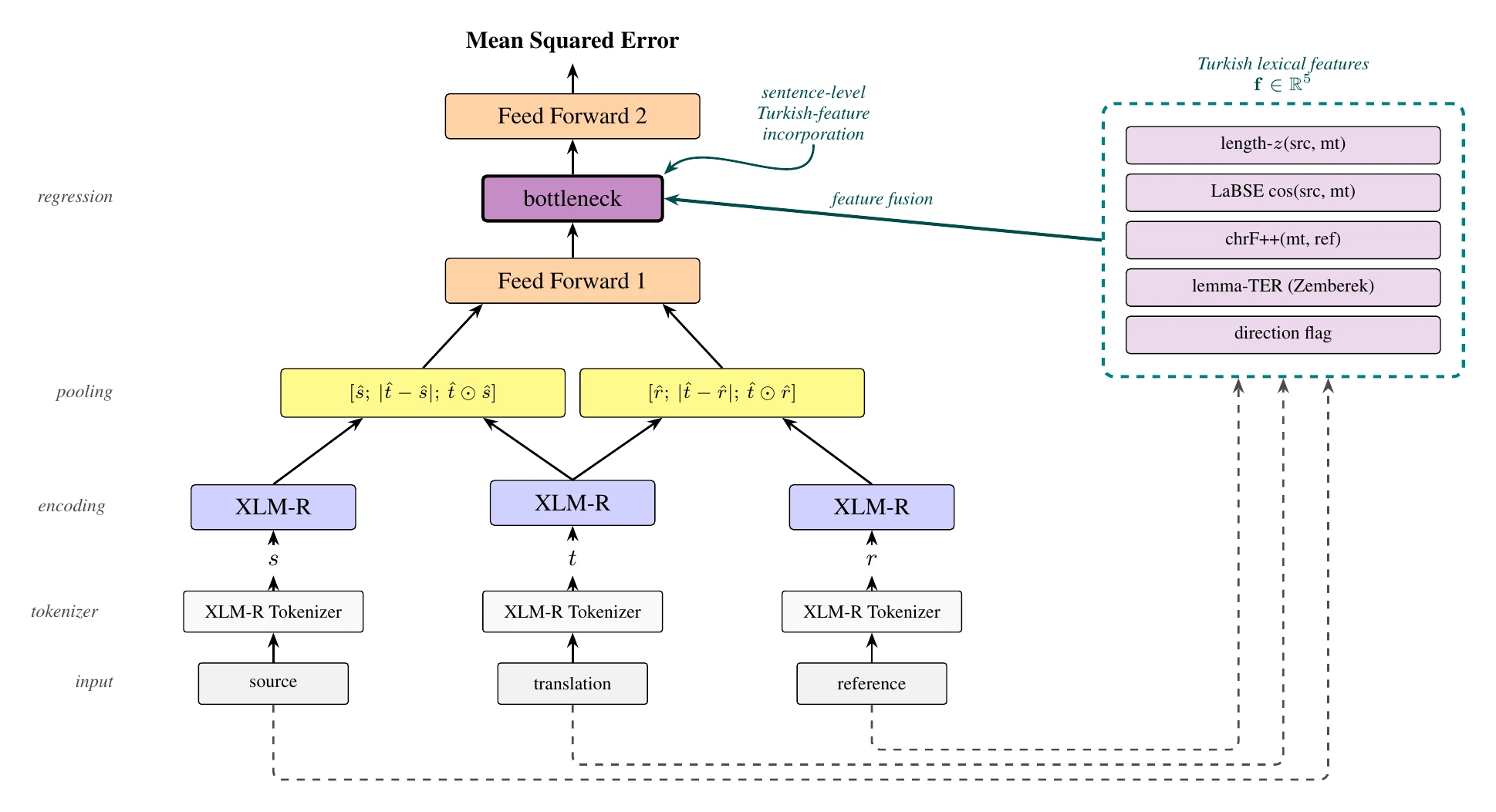
Five Turkish-aware features
Character overlap that survives suffix chains, lemma-level edit rate, a reference-free semantic anchor, an omission detector and a direction flag.
Never worse at step zero
W₂ and b₂ are zero-initialized, so training starts from scores identical to xCOMET-XL. Only ~330K parameters (<0.01% of the network) are trained.
One model, both directions
Fine-tuned on 35,357 WMT EN↔TR direct-assessment ratings (2017–18) with AdamW and MSE loss on a single A100. Held-out segment τ: 0.368 → 0.394.
Results
An expert MQM audit of 550 translations (4 professional translators, 11 LLMs × 2 directions) shows that TurCOMET agrees best with human judgment.
Correlation with expert MQM judgments
Segment level n = 550, system level n = 22. Higher is better.
| Metric | Pearson | Spearman | Kendall | |
|---|---|---|---|---|
| Segment | BLEU | 0.385 | 0.335 | 0.256 |
| xCOMET-XL | 0.419 | 0.350 | 0.267 | |
| TurCOMET | 0.436 | 0.383 | 0.291 | |
| System | BLEU | 0.828 | 0.852 | 0.628 |
| xCOMET-XL | 0.950 | 0.802 | 0.636 | |
| TurCOMET | 0.976 | 0.913 | 0.749 |
Where the gain comes from. Segment-level Δτ = +0.0247 overall (95% CI [+0.004, +0.049], p = 0.022), carried almost entirely by TR→EN (Δτ = +0.049, p < 0.001). In EN→TR the two neural metrics are statistically indistinguishable.
LLM leaderboard on TurkDoc-MT
Averaged over both directions, sorted by the human MQM judges (negated z-score, higher = better).
| Model | Humans | BLEU | xCOMET-XL | TurCOMET |
|---|---|---|---|---|
| gemma-4-31B-it | +0.32 | 31.3 | 0.814 | 0.714 |
| translategemma-27b-it | +0.26 | 21.4 | 0.805 | 0.709 |
| translategemma-12b-it | +0.22 | 19.0 | 0.785 | 0.695 |
| gpt-oss-120b | +0.21 | 22.5 | 0.782 | 0.688 |
| gemma-3-12b-it | +0.21 | 25.5 | 0.766 | 0.675 |
| gemma-3-27b-it | +0.17 | 28.7 | 0.782 | 0.686 |
| gpt-oss-20b | −0.19 | 22.4 | 0.749 | 0.665 |
| Qwen3.5-9B | −0.20 | 22.6 | 0.734 | 0.657 |
| translategemma-4b-it | −0.30 | 10.1 | 0.732 | 0.651 |
| Llama-3.1-8B-Instruct | −0.42 | 16.2 | 0.668 | 0.607 |
| gemma-3-4b-it | −0.43 | 14.6 | 0.665 | 0.606 |
TurkDoc-MT benchmark
1,322 English–Turkish document pairs kept at their native document boundaries, preserving discourse-level context, across seven domains from curated Wikipedia prose to multi-thousand-word TED talks.
| Domain | Source | Docs | Mean words | 90th pct. | 99th pct. |
|---|---|---|---|---|---|
| Wikipedia articles | FLORES-200 | 200 | 72.8 | 106.1 | 124.2 |
| Technical & scientific | TWiST | 200 | 119.9 | 205.4 | 363.3 |
| Educational dialogue | XQuAD | 200 | 134.1 | 190.4 | 330.5 |
| Journalistic prose | NTREX-128 | 122 | 342.9 | 543.6 | 689.1 |
| Legal rulings | AYM | 200 | 107.2 | 193.1 | 426.3 |
| Web crawl | DocHPLT | 200 | 225.1 | 348.1 | 1,260.0 |
| Spoken language | TED2020 | 200 | 2,646.3 | 3,285.4 | 4,495.6 |
| Total | 1,322 |
Released resources
Everything needed to use TurCOMET, reproduce the training, and re-run the meta-evaluation.
The TurCOMET checkpoint (bf16, ~7 GB). Scores (source, translation, reference) triplets in both directions.
Dataset TurCOMET/TurkDoc-MTThe benchmark: 1,322 document-level EN↔TR pairs across seven domains.
Dataset TurCOMET/TurkDoc-MT-MQM-Annotations2,200 expert MQM annotations (error spans, categories, severities, z-scores) from four professional translators.
Dataset TurCOMET/TurkDoc-MT_with_model-translationsTurkDoc-MT with the EN→TR and TR→EN translations produced by every evaluated LLM.
Dataset TurCOMET/wmt-da-en-tr_tr-enTraining data: 35,357 WMT EN↔TR DA ratings with precomputed features and the exact 90/5/5 splits.
Citation
If you use TurCOMET or TurkDoc-MT, please cite:
@inproceedings{uz-etal-2026-turcomet,
  title     = {{TurCOMET}: A Morphologically-Aware Evaluation System for
               Document-Level {T}urkish-{E}nglish Machine Translation},
  author    = {Uz, Atahan and Akda{\u{g}}, H{\"u}seyin Emir and
               {\"U}sk{\"u}darl{\i}, Susan},
  booktitle = {Proceedings of the 2026 Conference on Empirical Methods
               in Natural Language Processing},
  year      = {2026},
  address   = {Budapest, Hungary},
  publisher = {Association for Computational Linguistics}
}